Table of contents
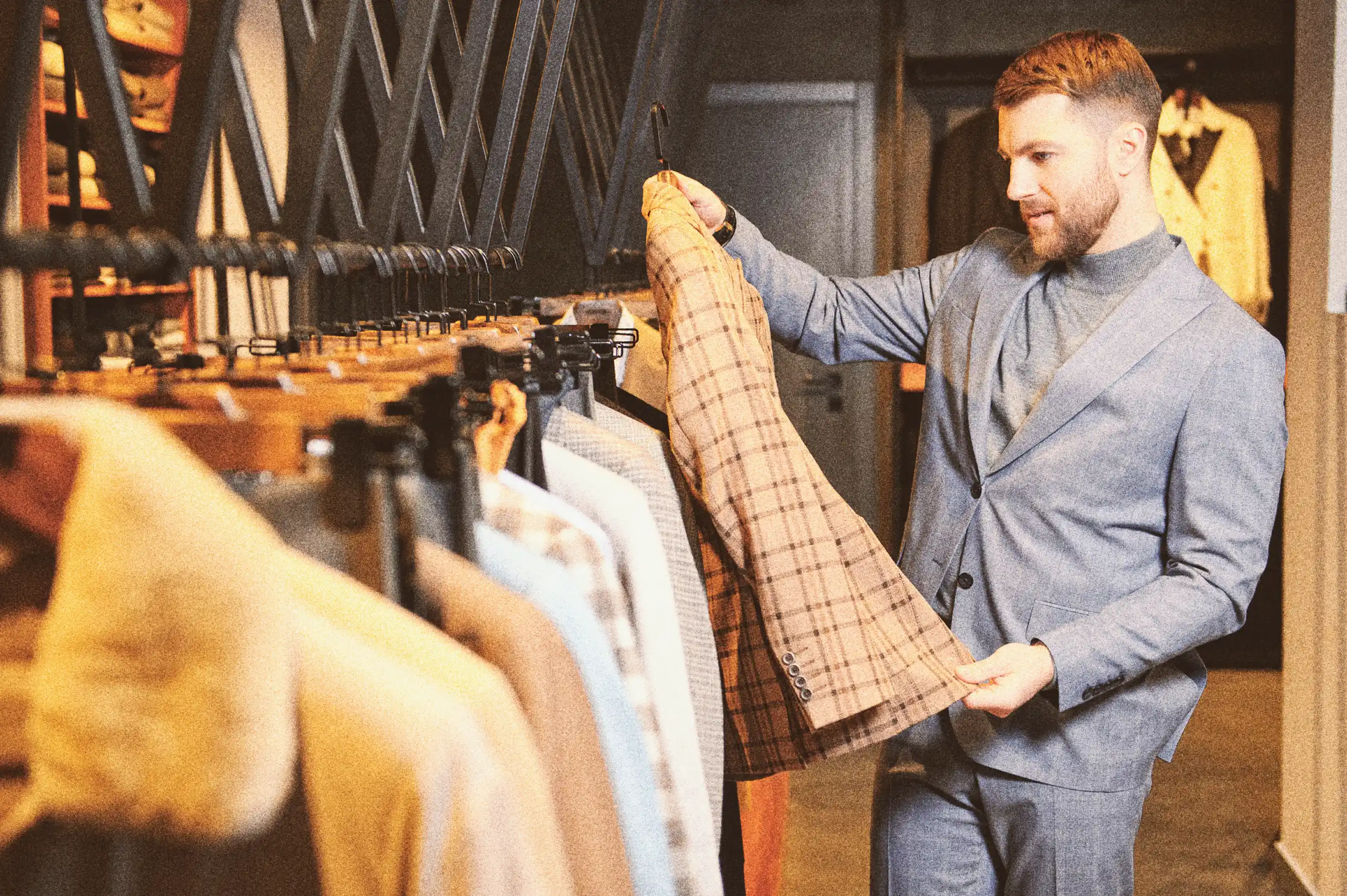
First of all, it is important to understand how urgently you need the suit. If you just remembered that your friend’s wedding is tomorrow or in three days and you don’t have anything suitable to wear, your options are limited. You can buy a ready-made suit or opt for a so-called ready-to-fit suit – a model that has been specially designed to be fitted, often including simple alterations in the price.
Deciding between a ready-made suit and a made-to-measure suit
It is important to know that even an excellently cut suit rarely fits perfectly off the rack. Statistically, around 25% of men find a brand with a standard cut that suits their build – but since you can’t try on every brand, the real chances are much lower.
In addition, well-fitting cuts are often more expensive, which makes it difficult to find a suitable budget suit.
If you have time for adjustments, the situation improves significantly. And if time is not an issue, a tailored suit usually fits better and costs less than a fully altered ready-to-wear suit.
A tailored suit is a very common and sensible choice, because 90% of the visual impact of a suit comes from the fit. Even the most luxurious fabrics won’t help if the garment doesn’t fit well. Around two thirds of men have a certain asymmetry due to genetics or sports injuries – a well-made suit can be tailored to fit any body shape.
How the jacket cut influences formality
In the following, we will use the term formality more often. Remember this: A double-breasted jacket always looks more formal than a comparable single-breasted jacket. Wearing a vest also significantly increases the perceived elegance of a suit – even if it hardly changes the price.
We’ll show you the key differences between ready-to-wear and bespoke suits so you understand what you’re paying for and what you really need. But first, a few points that can vary regardless of the style.
Suit cuts: classic, slim fit and loose fit
The first point: the cut.
Classic suits (including variations such as tuxedos or cutaways) are the most formal. They fit most body types and – depending on the styling – can be worn in many situations.
Slim-fit suits emphasize the silhouette, are particularly suitable for slim men and pose a challenge for larger body shapes. They look a little less formal, but with the right accessories can be perceived as a conscious style choice.
Loose cuts (e.g. hunting, riding or yacht style) offer the greatest comfort and conceal figure problems. They are often worn as leisure suits – for men who don’t want to do without suits even in their free time.
Choosing the right fabric for tailored or made-to-measure suits
The second point: the material.
Very expensive suits do not use cheap materials, but the fabric still only accounts for a small part of the production costs. Cheap polyester is available wholesale for less than CHF 0.5/m, while branded Vicuña wool can cost up to CHF 10,000/m.
High-quality wool starts at around CHF 200-300/m.
Cotton or linen suits can be very good and are usually cheaper than 100% wool. However, pure cotton or linen are more likely to be used for loose-fitting suits.
Synthetic fibers can be cheap or expensive – you often can’t tell by looking at them. But: Synthetics “breathe” poorly and usually have a cheap sheen. Cheap synthetics wear out quickly, especially on pants – holes can appear after just two intensive uses.
Poor quality wool feels uncomfortable and wears out quickly. Good wool has a fiber thickness of 11-20 microns. 17-20 microns are more abrasion-resistant and more suitable for everyday use. The finer the fiber, the softer, stronger and more luxurious it looks – but also more expensive and less durable.
Cheap made-to-measure suits often contain misleadingly declared fabrics – you only realize the truth when they wear out quickly or become uncomfortable.
High-quality blends can be very practical – and 100% wool is not a must for a good suit.
How color influences formality
The third point: the color.
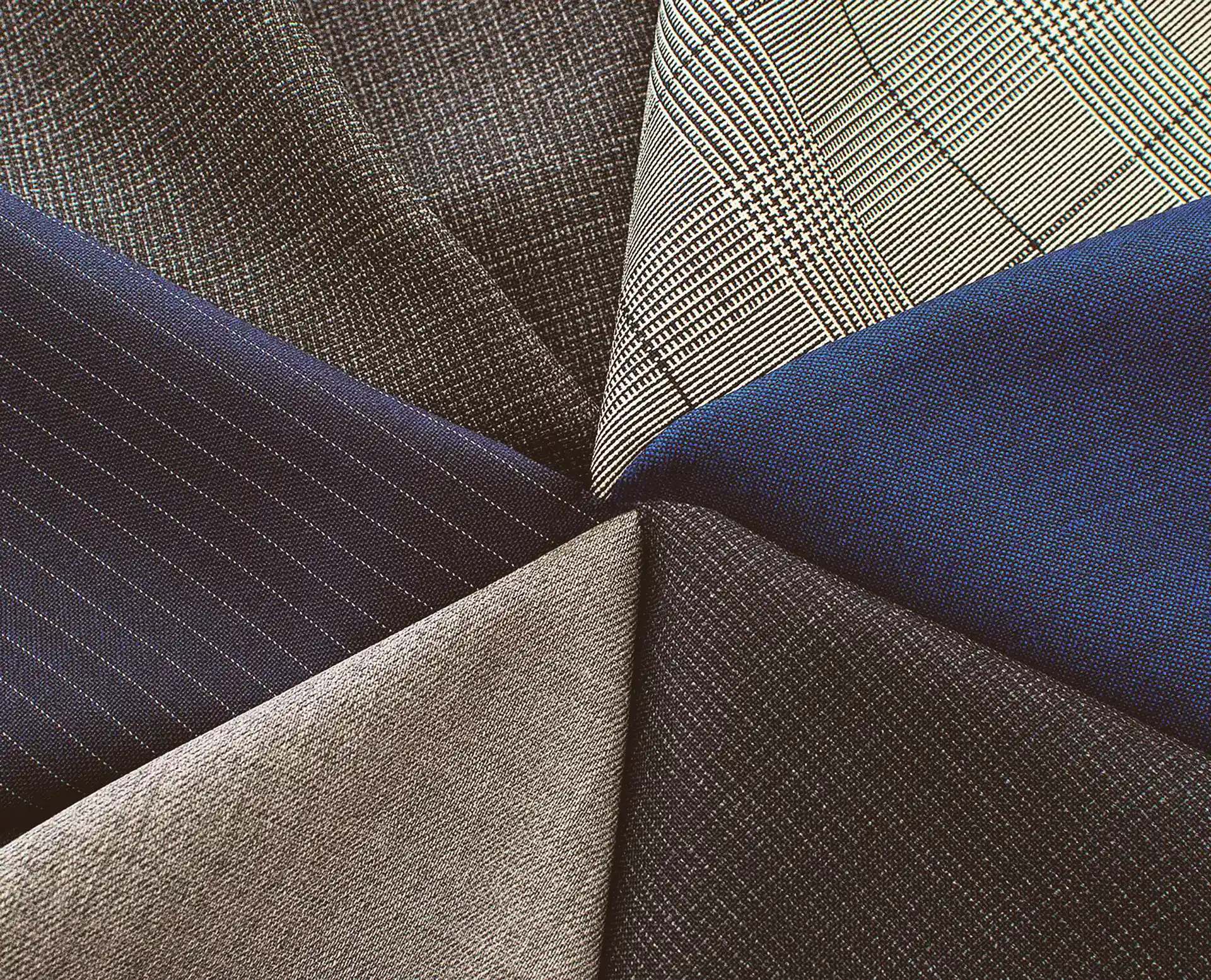
In classic menswear, a black suit is only for your own wedding or a funeral.
Dark gray, dark brown or navy blue are suitable for formal occasions.
For business or elegant but not formal events, gray is ideal. For the office or as a versatile everyday suit, navy blue is the best choice.
Rule of thumb: the darker, the more formal.
Fine patterns such as stripes, checks or herringbone are permitted, but appear somewhat less formal.
Bright colors are intended for summer or hot climates – and are completely unsuitable for formal occasions. Colorful or strikingly patterned suits are maximally informal and show that you are wearing the suit out of conviction – not out of obligation.
The limits of alteration tailoring
When you buy a ready-to-wear suit, you need to assess the fit:
- The shoulders of the jacket should sit at the shoulder end.
- Sleeves should show 1-2 cm of shirt cuff.
- Pants should rest on the shoes with a slight crease.
If the suit restricts your movement, it’s not the right one – unless you are sporty and only used to very loose clothing. Action movies notwithstanding: you can’t comfortably run away from terrorists or kick high kicks in a normal suit.
Many faults can be rectified by a good tailor – but it is better to seek advice beforehand (with clear photos or video) to avoid paying more for alterations than for a made-to-measure suit.
A good tailor can never achieve the same fit with a ready-to-wear garment as with a made-to-measure one.
Remember: Collar and lapel lines are difficult to adjust – they should already fit perfectly in the store.
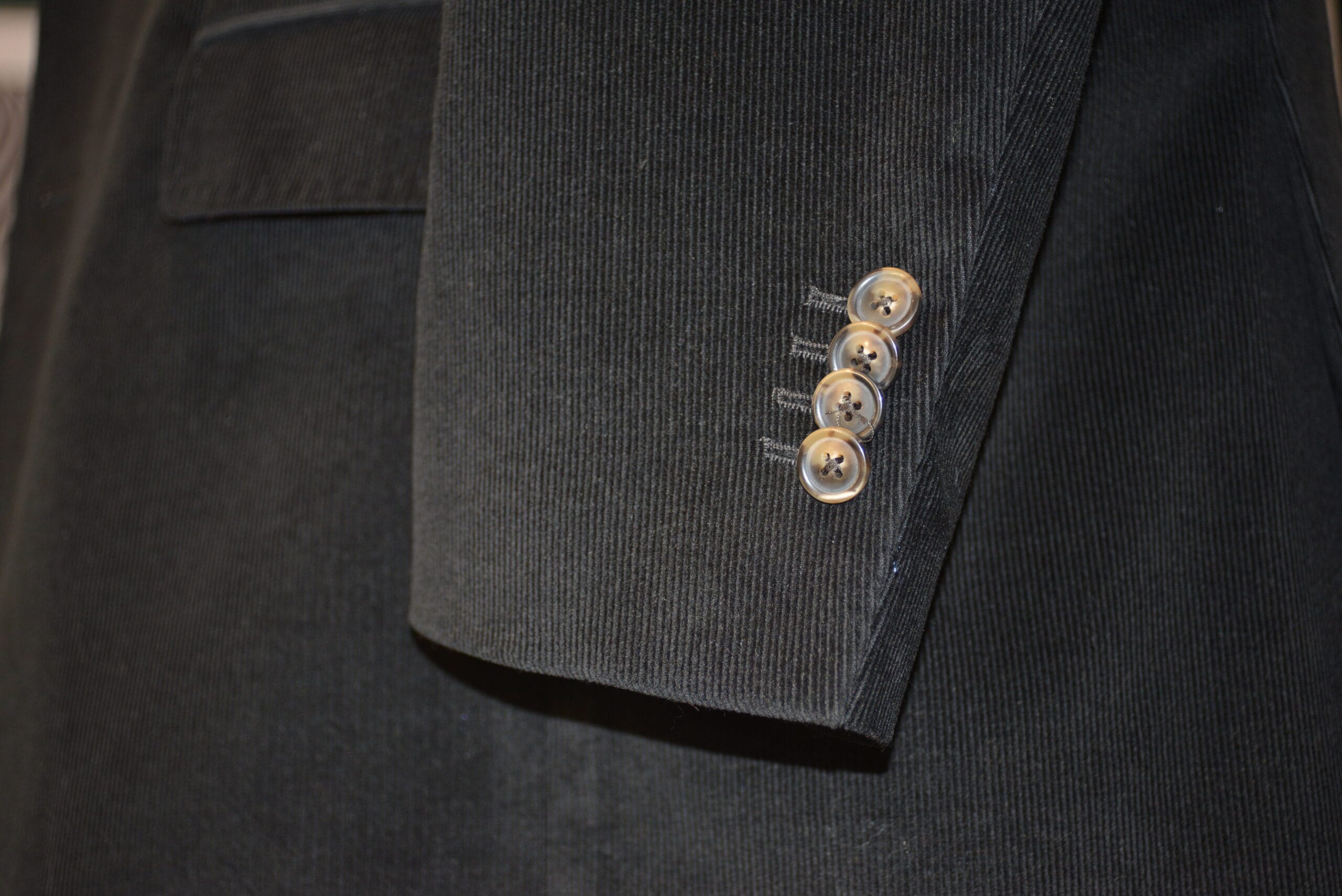
Decorative sleeve buttons (without any real function) are a sign of cheap suits – and can hardly be changed later in a meaningful way.
The most important differences between ready-to-wear suits are shown in the following table:
| Cheap Asia | Expensive-Asia | Cheap Europe | Mid-Europe | Expensive-Europe | Lux-Europe | Switzerland | |
|---|---|---|---|---|---|---|---|
| Local sales price from, CHF | 7 | 25 | 80 | 200 | 1000 | 3500 | Not available |
| Price Switzerland from, CHF | 100 | 120 | 250 | 500 | 1500 | 5000 | Not available |
| Cut type | Automatic | Automatic | Automatic | Automatic | Automatic | Automatic | |
| Synthetic in the fabric | Fabric base | Fabric base | Fabric base | Included | Not included | No | |
| Fabric brands used | No | No | No | Rare | Partial | Safe | |
| Basic construction | Glue | Glue | Glue | Glue | Adhesive/cheap canvas | High quality canvas | |
| Synthetic lining | Always | Always | Always | Often | Rare | Impossible | |
| Fit quality | A matter of luck | A matter of luck | A matter of luck | Often good | Good | Good | |
| % perfect fit | <2 | <2 | <2 | ~5 | ~10 | ~15 | |
| Natural buttons | No | No | No | Rare | Often | Safe | |
| Decorative sleeve buttonholes | Yes | Yes | Yes | Often | Rare | Impossible | |
| Uniform seams and product lines | A matter of luck | A matter of luck | A matter of luck | A matter of luck | Often | Safe | |
| Sample voting | Bad | Good | A matter of luck | Good | Very good | Ideal |
How to recognize overpriced suits and evaluate clothing options
It is important to understand that price is not a reliable indicator of quality. Many sellers take advantage of customers’ lack of knowledge and sell suits at significantly inflated prices, citing claims such as “genuine Italian fabrics” or the brand’s country of origin. In Zurich, we have seen ready-to-wear suits being sold for three to four times more than their actual value.
When buying a ready-made suit, you should always try on the complete set. If you are buying the suit to complement your existing wardrobe, you should assess how well it goes with your existing shirts and accessories and how it fits into the overall context of your wardrobe.
Why measuring is important for tailored and made-to-measure suits
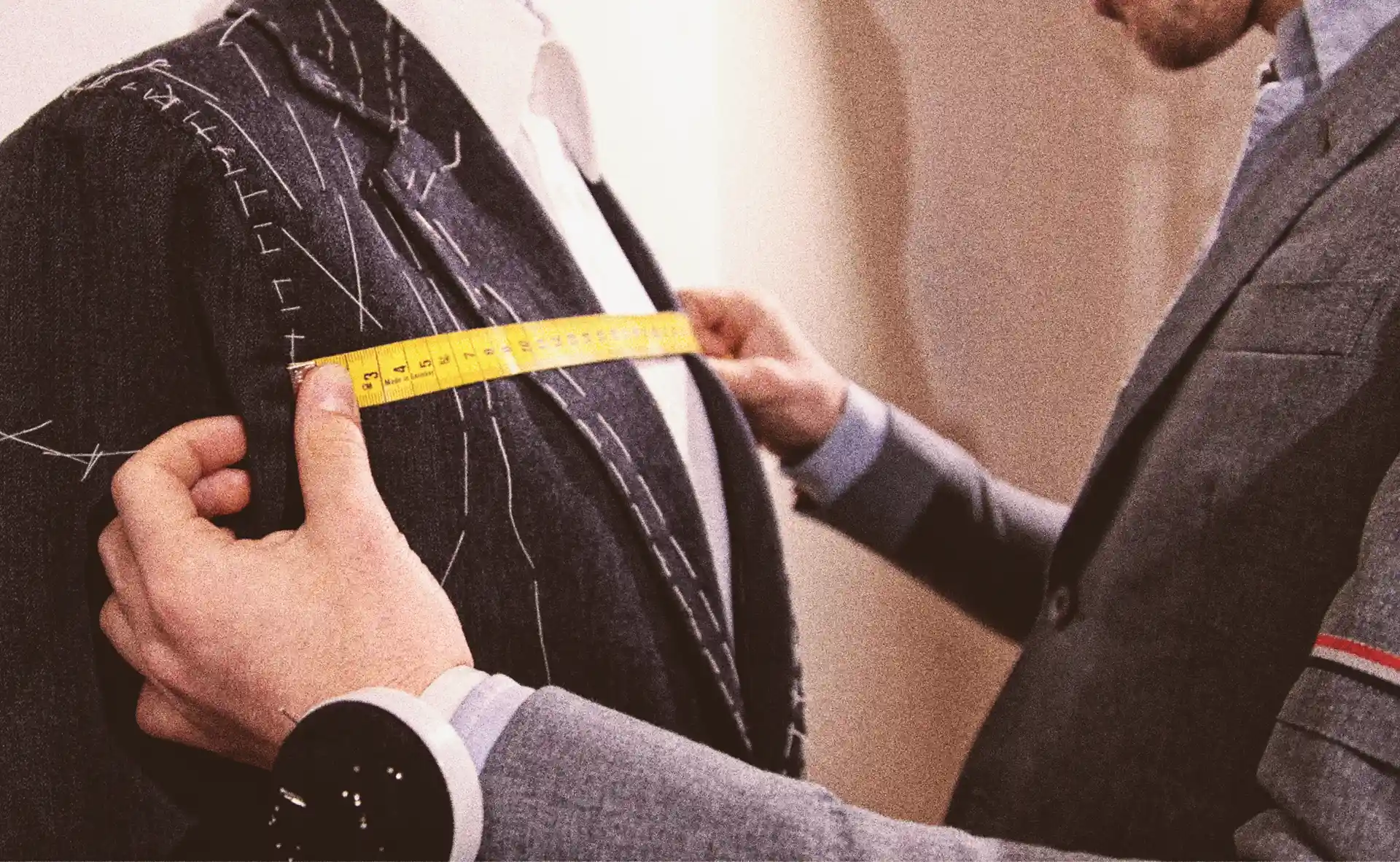
When transitioning to custom-made suits, it is important to emphasize one key point: The fit of a made-to-measure suit depends heavily on the skill of the person taking your measurements. Of course, a suit can be poorly made even with perfectly taken measurements – but with inaccurate measurements, a good result is impossible.
Therefore, when ordering a suit, you should make sure that the person taking the measurements has a deep understanding of tailoring techniques. Many people have asymmetrical limbs – such as arms or legs of different lengths. This can easily be checked with the help of a friend. If such asymmetries are present, you should make sure that they are taken into account in the tailor’s measurements. If this is not the case, it is a clear sign that you should not order a suit there.
The likelihood of getting a high-quality suit is generally higher if it is made in a country with a long tradition of tailoring, such as Italy or the United Kingdom. A high-quality suit requires a number of steps to be carried out by hand, and these techniques are not taught in traditional tailoring schools. The mastery of these steps can only be passed on by an experienced craftsman who has learned and executed them over many years.
Quality of bespoke suits: Craftsmanship vs. country of origin
In today’s globalized world, this knowledge is no longer limited to certain countries, but it is still rare to find a tailor shop outside of such countries that is capable of producing a truly exceptional suit. However, this does not mean that inferior production cannot exist in traditional countries.
There are two main methods for making a bespoke suit:
Made-to-measure (M2M) means that you try on a sample suit and the tailor adjusts the cut to the body shape after taking the basic measurements. In this method, production is usually divided into individual steps, and the lower the quality level of the suit, the fewer options are offered. With high-quality M2M suits, the choice of options can be almost unlimited.
Bespoke production: Fitting, individualization and work intensity
Bespoke production: Fitting, individualization and work intensity
Bespoke begins with the tailor taking the basic measurements, followed by several fittings of the unfinished garment. The suit is gradually adapted to the individual body. A good tailor needs two fittings for an average body shape and three for a complex figure.
The main advantage of Bespoke is that – even with the cheapest option – you can usually request every detail you want and get a truly individual garment. For most buyers, however, this level of customization is not a key concern.
There are many myths about the fundamental differences between Made-to-measure (M2M) and Bespoke suits, often claiming that a single tailor always delivers the better fit. In reality, M2M produces the better result for the same effort in most cases. The Bespoke method requires significantly more working time and a higher level of craftsmanship to achieve the same result and therefore cannot be offered at the same price.
Reaching the level of a high-quality M2M suit – where every step is carried out by a specialized skilled worker – is hardly possible for a single tailor or a small team. The main difference between Bespoke and M2M lies in the type of tailoring. With Bespoke, the tailor designs a completely new pattern based on his personal understanding of cutting techniques. With M2M, the measurements and body characteristics are entered into a software program that calculates the optimum cut. For high-quality M2M suits, the system offers a wide range of customization options and the design is optimized by a tailoring expert to achieve the desired result.
Why modern made-to-measure clothing is superior to manual cutting
In contrast to other areas of tailoring, where automation can reduce quality, modern cutting systems cut fabrics with much greater precision than a human – so there is no practical advantage to manual cutting.
Of course, the M2M system is designed to produce more standardized suits, and garments with many individual options take much more time. A highly skilled bespoke tailor who is even capable of delivering comparable quality is usually booked up a year in advance – and still can’t deliver an exceptional piece any faster.
The most important differences between custom-made suits according to body measurements are shown in the second table:
| Cheap Asia | Expensive-Asia | Cheap Europe | Mid-Europe | Expensive-Europe | Lux-Europe | Cheap Bespoke | Expensive Bespoke | Lux Bespoke | Switzerland Bespoke | |
|---|---|---|---|---|---|---|---|---|---|---|
| Production time (ex. delivery) | 4-7 days | 7-15 days | 2-3 weeks | 4-8 weeks | 6-12 weeks | 2-6 months | 1-2 months | 3-8 months | 9-18 months | 4-12 months |
| Local sales price from, CHF | 80 | 200 | 600 | 900 | 1600 | 7000 | 1000 | 2500 | 8000 | – |
| Price Switzerland from, CHF | 400 | 600 | 900 | 1200 | 2500 | 10000 | 2500 | 5000 | 10000 | 10000 |
| Cut type | Automatic | Automatic | Automatic | Automatic | Automatic | Automatic | Automatic | Mainly by hand | by hand | Mainly by hand |
| Basic construction | Glue | Glue/cheap canvas | Glue | Glue/cheap canvas | Different canvas | High quality canvas | Glue/cheap canvas | Different canvas | High quality canvas | Different canvas |
| Synthetic in the fabric | Yes | Often | Yes | Often | Rare | No | Rare | No | No | No |
| Synthetic in the insole | – | Yes | – | Often | Rare | No | Often | Rare | No | Rare |
| Branded fabrics | No | Rare | Partial | Often | Yes | Safe | Often | Yes | Safe | Safe |
| Natural buttons | No | To order | To order | To order | Often | Safe | To order | Often | Safe | Safe |
| Synthetic lining | Yes | Yes | Yes | Often | Rare | No | Often | Rare | No | No |
| Yarn quality | Low | Low | Low | Good | Good | Perfect | A matter of luck | Good | Perfect | Good |
| Decorative sleeve buttonholes | Yes | Often | Often | Rare | No | Unacceptable | Rare | No | Unacceptable | No |
| Decorative lapel buttonhole | Yes | Often | Often | Rare | No | Unacceptable | Rare | No | Unacceptable | No |
| Fit quality | A matter of luck | Good | A matter of luck | Good | Good | Ideal | A matter of luck | Good | Ideal | Good |
| % perfect fit | <5 | ~50 | ~30 | ~50 | Measurement-dependent | Measurement-dependent | ~50 | Tailor-dependent | Tailor-dependent | Tailor-dependent |
| Fit % with correct measurements | <10 | ~70 | ~40 | ~70 | ~90 | 100 | ~50 | ~80 | ~90 | ~70 |
| Number of fittings | No | No | No | 1 | 1 | 1 | Up to 6 | Up to 3 | Up to 3 | Up to 3 |
| Selection options | Narrow | Wide | Narrow | Moderate | Wide | Comprehensive | Moderate | Wide | Comprehensive | Wide |
| Uniform seams and product lines | A matter of luck | A matter of luck | A matter of luck | Rare | Often | Safe | Rare | Often | Safe | Often |
| Sample voting | Bad | A matter of luck | A matter of luck | Good | Good | Ideal | A matter of luck | Good | Ideal | Good |
| Handmade:* | ||||||||||
| Collar shaping | No | No | No | No | Rare | Yes | Rare | Often | Yes | Rare |
| Fastening the undercollar felt | No | No | No | No | Rare | Yes | Rare | Often | Yes | Often |
| Collar fastening | No | No | No | No | Rare | Yes | Rare | Often | Yes | Often |
| Reverse forming | No | No | No | No | Rare | Yes | Rare | Often | Yes | Rare |
| Lapel fastening | No | No | No | No | Rare | Yes | Rare | Often | Yes | Often |
| Edge finishing of collar and lapel | No | No | Rare | Rare | Often | Yes | Often | Yes | Yes | Often |
| Lining attachment | No | No | No | No | Rare | Yes | Rare | Often | Yes | Often |
| Production of the inside pockets | No | No | No | No | Rare | Yes | Rare | Often | Yes | Often |
| Insole construction | No | No | No | No | Rare | Yes | Rare | Often | Yes | Often |
| Shaping of the chest section | No | No | Rare | Rare | Rare | Yes | Rare | Often | Yes | Often |
| Stapling the insert | No | No | No | Rare | Rare | Yes | Rare | Rare | Yes | Rare |
| Shoulder shaping | No | No | Rare | Rare | Rare | Yes | Rare | Rare | Yes | Rare |
| Shoulder fastening | No | No | No | Rare | Rare | Yes | Rare | Often | Yes | Often |
| Buttonhole processing | No | No | No | No | Rare | Yes | Rare | Rare | Yes | Rare |
| Button fastening | No | Rare | Rare | Often | Often | Yes | Often | Often | Yes | Often |
| Piping on the pocket | No | No | No | No | Rare | Yes | Rare | Often | Yes | Often |
| Fastening the flap pocket | No | No | No | No | Rare | Yes | Rare | Often | Yes | Often |
| Processing the inside pocket | No | No | No | No | Rare | Yes | Rare | Rare | Yes | Rare |
| Design options for the waistband | No | No | Rare | Rare | Rare | Yes | Rare | Often | Yes | Often |
| Processing of the waistband | No | No | No | No | Rare | Yes | Rare | Rare | Yes | Rare |
| Trouser pleats | No | No | No | No | Rare | Yes | Rare | Rare | Yes | Rare |
| Decorative stitching | No | No | No | No | Often | Yes | Often | Often | Yes | Often |
| Final shaping and ironing | No | No | Rare | Rare | Often | Yes | Often | Yes | Yes | Yes |
| Hem processing | No | Rare | Rare | Often | Often | Yes | Often | Yes | Yes | Yes |
| Slot processing | No | No | No | No | Rare | Yes | Rare | Often | Yes | Often |
| Removing the basting stitches | No | No | No | Rare | Often | Yes | Often | Yes | Yes | Yes |
** Some modern sewing machines can imitate decorative hand stitches, making it difficult for non-professionals to distinguish them from real hand stitching.
They should understand that exceptions to this table do exist, but are too rare to include in your planning.
Additional options for made-to-measure and custom suits
There are many options for a suit that have not yet been mentioned and are not directly dependent on the manufacturer. Let’s take a look at these too:
- Fabric durability. Classic super wool fabrics in the Super 100 to 140 range are traditionally considered the most durable. Cashmere, vicuña or natural blended fabrics have many positive properties, but if you want to wear the suit every day, you should choose a thick, abrasion-resistant fabric.
- Fabric feel. For most people, this is a crucial factor, as a pleasant tactile feel creates confidence in the quality of the garment. Modern finishing processes vary greatly – always feel the fabric yourself and hold it against your body to make sure it feels right.
- Fabric weight. The denser the fabric, the warmer and more durable it is. The weight is given in grams per square meter for single-layer fabrics. Suits suitable for summer: up to 200 g/m². Transitional season (spring/autumn): 200-320 g/m².
- Fabric uniformity. High-quality fabrics have a uniform thickness over the entire surface. All branded fabrics meet this standard. Cheaper fabrics or counterfeits of branded fabrics may have irregularities. Irregular fabrics should be avoided as their composition and durability are often questionable.
- Inner construction (interlining). A suit can be made without interlining, with half interlining or full interlining. The right inner construction gives the jacket its shape and helps to retain it. Formal suits should always include an interlining.
- Shoulder pads. They are indispensable for formal jackets. Their stiffness can vary. With asymmetrical shoulders, they can help to balance out the appearance of the jacket.
- Vents. A jacket can have no vents, one central vent or two side vents. This choice does not directly influence the formality (except for tuxedos & co.), but depends on comfort and style preferences.
- Buttons and positioning. Single-breasted jackets usually have 1 to 4 buttons at the front. Double-breasted styles offer more variation and use buttons both functionally and decoratively. The optimum number of buttons depends on your body type – if in doubt, ask for advice. The sleeve buttons range from 2 to 4 and can touch or slightly overlap – this is purely a design element.
- Decorative inner lining. An important element for expressing personality. It can make even a conservative jacket look less formal. Lining options are almost unlimited and can emphasize your individuality. In the highest price range, custom-made print linings are sometimes offered. Important: Compare the inner fabric with the outer fabric before you decide – even two high-quality fabrics can work badly together.
- Lining types for jackets. Jackets can be fully lined, partially lined or unlined. In high-end tailoring, the main aim is to maintain structure over the years. Such jackets usually contain a full interlining and full lining to maintain shape and minimize wear.
- Pockets and their placement. The shape of the pockets has a strong influence on the overall impression. Patch pockets look more casual than piped pockets. Unusual shapes or positions indicate informality. A talented designer can use pocket shape, position and lapel design to emphasize your figure and create an individual style that stands out from the crowd but still remains within the dress code. Cheaper suits often have little choice in pockets, whereas high-end tailoring allows for fully customized solutions. Note: Jacket pockets are not intended for heavy items – so tickets are better than a wallet. They are more for looks.
Key design elements for a tailor-made suit
Here are some additional tips on inconspicuous but important details:
- Lapel style influences how formal a suit looks. The width of the lapel should be proportional to your physique. Narrow lapels are occasionally trendy, but often quickly look outdated and cheap. It is better to avoid them for a long-lasting wardrobe.
- Buttons are key elements of the look. On high-quality suits, they are usually made of natural horn or – depending on the style – precious metals.
High-quality plastic imitations appear acceptable at first glance, but wear out quickly and often break during cleaning. - Lining quality must match the outer fabric. It makes no sense to buy a cashmere suit if the lining is synthetic – this reduces both comfort and durability.
Quality instead of quantity for men’s suits
If you need or can afford several suits, quality should always take precedence over quantity. A really high-quality suit will still look great after 20 years – the old adage that you can “pass on suits to your grandchildren” is no joke. A cheap suit, on the other hand, can look worn out after 2-3 months.
When ordering a made-to-measure suit, it is often worth ordering a second or even third pair of pants at the same time. Pants wear out much faster than jackets, and it is often impossible to order matching pants at a later date. Even very expensive fabrics can differ noticeably in shade from batch to batch, resulting in a visible color difference between trousers and jacket.
Any reputable retailer selling you a suit should be able to give you detailed information on the above options. If someone can’t even explain the basics you see here, you shouldn’t buy a suit from them.
Risk levels for bespoke suits: Low-cost options vs. European manufacturing
Risk levels for bespoke suits: Low-cost options vs. European manufacturing
Finally, the most important parameters that you should define for yourself before you order a made-to-measure suit:
- If you are prepared to take a certain amount of risk
If you accept that the suit may not fit perfectly, may not hold its shape for long or may not be made from the promised fabric, you can try ordering a “made in Asia” suit. The typical feature of such suits on the market is a price below CHF 600 and extremely short delivery times – production is often promised within two weeks.
Medium and high-quality manufacturers can also deliver a rush order in this time, but it will cost two to three times the normal price. If you are comfortable with this level of risk, we offer a measure service and can recommend appropriate online manufacturers – their prices are around half of what you would pay elsewhere.
2. if you want an affordable European suit
Be careful not to get an Asian product that is claimed to be European. Sellers often advertise short delivery times as an advantage – if you are promised two weeks, you know where the suit comes from. In this price range, it is crucial that the outer fabric and lining are made from natural materials. The best option: choose inexpensive Italian weaving mills, note the fabric names or codes and compare the fabric samples with the finished suit. The likelihood of getting synthetic fabric in this segment is high. A good suit should have functional buttonholes on the sleeves. To check whether your measurements have been taken correctly, it is advisable to first visit a high-quality tailor and note which parts of the body are asymmetrical.
This way you can check later whether these asymmetries have been taken into account in the finished suit. We had a customer who ordered made-to-measure suits for 30 years without anyone ever noticing that one arm was two centimetres shorter than the other.
3. if you buy a high-priced suit
Unfortunately, you also have to be careful not to pay for a brand name or poor workmanship. All the previous tips still apply. In this segment, it is helpful to analyze detailed photos of real garments – not catalog pictures, but unadorned photos. For suits with checks or stripes, the patterns should match very well if the price is over CHF 2,000 and perfectly from CHF 4,000. Pay attention to symmetry in key details such as pockets, seams and the center back seam. If you have any doubts about the quality of your finished suit, you are welcome to bring it to us – we offer a free brief consultation on the visible strengths and weaknesses of the piece.
It is important to understand that the crucial and most expensive part of a suit is often on the inside – and this is difficult to judge from the outside. Sometimes even very expensive fabrics are sewn onto poorly constructed inner layers.
But most importantly: choose the suit for yourself. It should make you feel confident, confident and beautiful – not just make an impression on others. Because no matter how perfect a suit is: Not everyone will like it – simply because not everyone has taste.
Leave a Reply